Spiegazione semplice
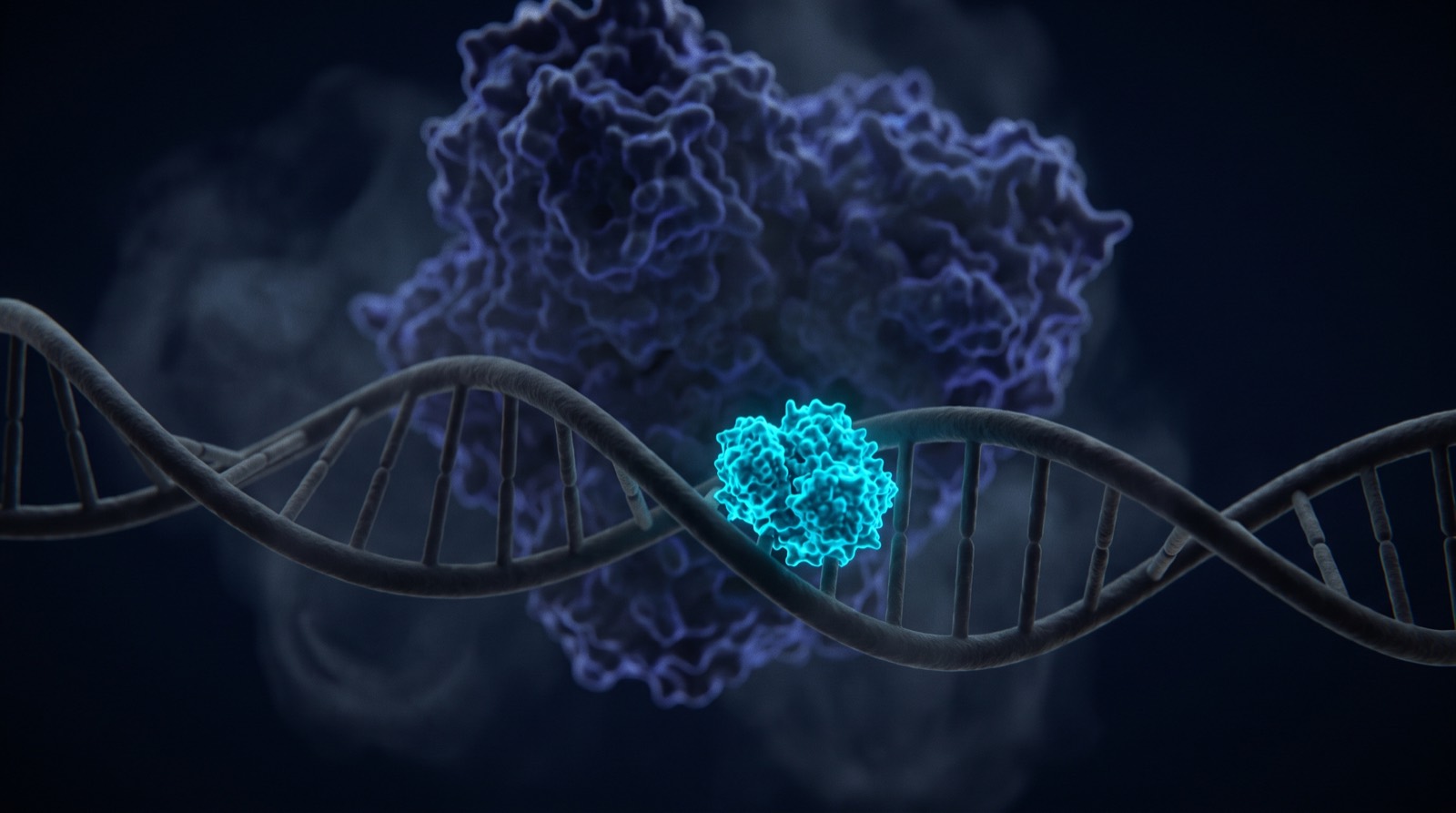
The biggest practical problem in gene editing is not the editing, it is getting the machinery into the right cells. The most common delivery vehicle, a modified virus, has a strict luggage limit, and Cas9 barely fits. Cas14 and its relatives are miniature versions of the same kind of enzyme, small enough to leave room for everything else you need to pack.
Approfondisci
Cas14 proteins (reclassified within Cas12f) are compact type V effectors of roughly 400–700 amino acids, discovered in uncultivated archaea. CasΦ (Cas12j), found in huge bacteriophages, is similarly small and notable for recognising a minimal T-rich PAM and processing its own guide RNA. Their size makes them attractive for AAV delivery, where the ~4.7 kb packaging limit is a hard constraint; native activity in human cells is generally lower than SpCas9 and much of the work is engineering to improve it.
Why size is the point
Adeno-associated virus, the workhorse of in vivo gene delivery, cannot carry more than about 4.7 kilobases. SpCas9 alone consumes most of that budget before you add a promoter, a guide and any regulatory sequence. A nuclease a third the size changes what is possible to deliver in a single vector, which is why an enzyme with modest laboratory activity still attracts serious engineering effort.
Where it stands
These are research-stage tools. They are used in laboratories and are being engineered for higher activity, and no therapeutic programme based on them has reached the clinic.
Sources
- Science (Harrington et al.) · 2018
CRISPR-Cas14 is a family of miniature RNA-guided nucleases ↗ - Science (Pausch et al.) · 2020
CRISPR-CasΦ from huge phages is a hypercompact genome editor ↗