Исчерпывающий путеводитель по редактированию генов.
Меню
Главная Учиться Новости Спросить Atlas
Изучить Технологии Заболевания Методы лечения Клинические исследования Компании Учёные Гены Исследования Учреждения
За пределами медицины Сельское хозяйство Этика Инвестирование Карта мира
Обучение и инструменты Начните здесь Глоссарий А–Я Сравнить технологии Хронология Списки и рейтинги ИИ-агенты ★ Сохранено API
О нас О нас Методология Источники данных Редакционная политика Контакты Отказ от ответственности

🧭 Режим с подсказками
Впервые в генетике? Мы объясняем каждый термин прямо в процессе просмотра, простым языком. Те же страницы — со встроенной подсказкой.

⚡ Взгляд эксперта
Биология вам уже знакома. Только содержание — чисто и компактно, без лишних пояснений. Это вид по умолчанию.

Язык интерфейса
Светлый режим

Technology · Earlier generation

Zinc Finger Nucleases

The first programmable gene-editing tool to reach patients — small, engineered proteins that grip DNA in three-letter blocks.

Phase III DNAcuts DNAprotein-guidedcompact
Clinical research Being tested in people in registered clinical trials. Being in trials is not evidence that a treatment works or is safe.

Простое объяснение

The original. Zinc fingers are small protein modules, each gripping about three letters of DNA, that can be chained together to recognise a longer sequence and joined to a cutting enzyme. They are difficult to design and they got there first: the earliest human gene-editing trials, more than a decade before CRISPR reached a patient, used zinc finger nucleases.

Углубиться в тему

Zinc finger nucleases fuse arrays of Cys2-His2 zinc finger domains — each contacting roughly three base pairs — to the FokI nuclease domain, used in pairs. Their compact size is a genuine advantage for AAV delivery. Their weakness is design: context-dependent binding between adjacent fingers makes engineering an array for a chosen sequence difficult, which is precisely the problem CRISPR made irrelevant.

Historical importance

ZFNs carried gene editing into humans. Sangamo's SB-728-T programme disrupted CCR5 in T cells of people with HIV from 2009, establishing that a targeted, permanent edit could be made in a patient's cells and administered safely enough to continue. Every subsequent editing programme was built on regulatory ground that work broke.

They remain in clinical development, particularly where compact size aids delivery.

Historical importance
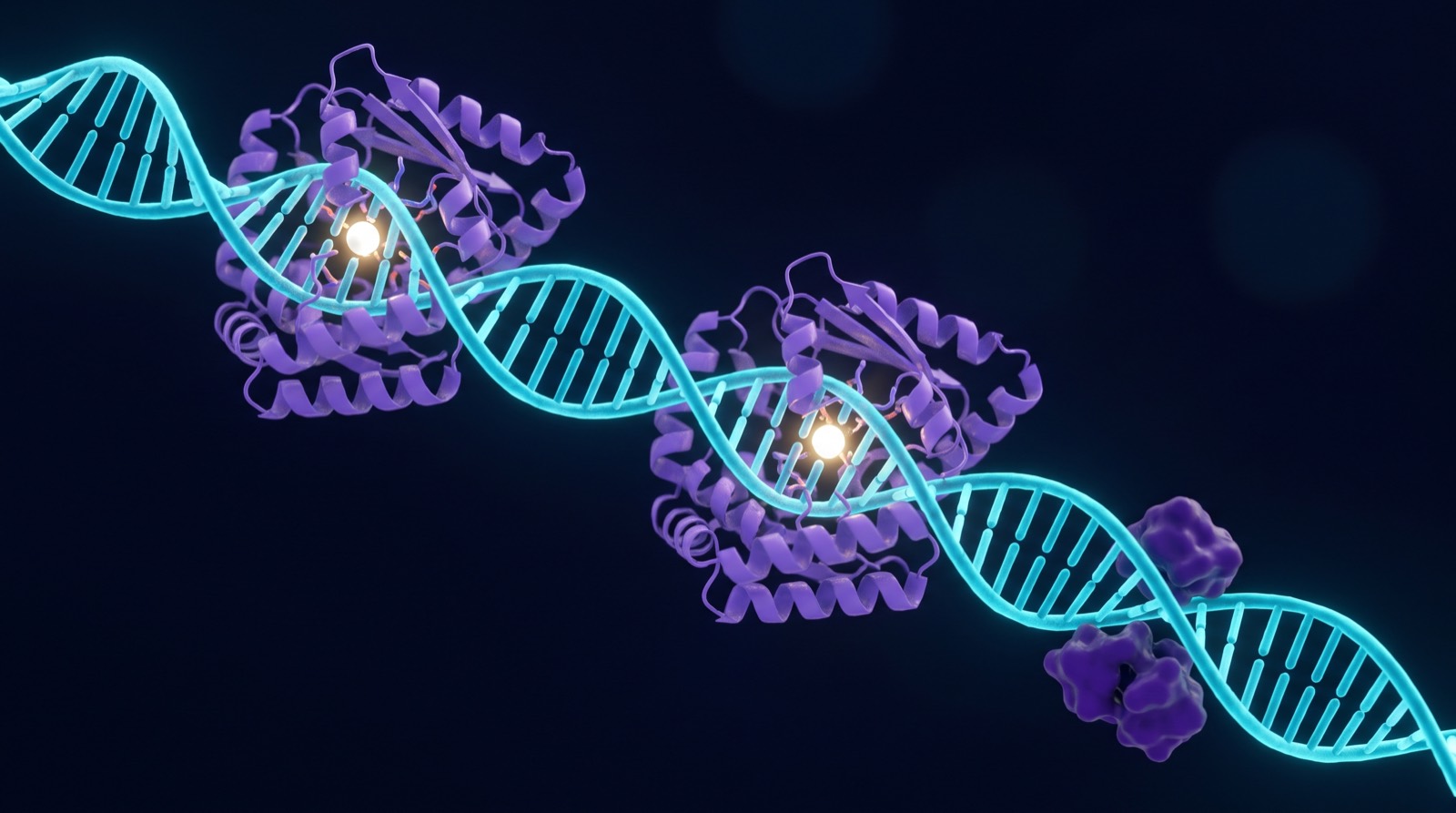
Zinc finger domains, each cradling a metal ion, reading DNA in blocks. Illustration generated for The CRISPR Atlas — a visual aid, not a photograph or a literal depiction of molecular structure.

Sources

Connected in the Atlas

Every entry on this site is linked to the others it relates to. These connections are part of the record, not a search result.

Только в образовательных целях Эта страница — справочный материал, а не медицинская консультация. Статусы исследований и регуляторных процессов меняются; проверяйте дату последнего обновления выше и уточняйте всё важное по первичным источникам, указанным на странице.