O guia definitivo sobre edição genética.
Menu
Início Aprender Notícias Perguntar ao Atlas
Explorar Tecnologias Doenças Tratamentos Ensaios Clínicos Empresas Cientistas Genes Investigação Instituições
Para além da medicina Agricultura Ética Investimento Mapa mundial
Aprender e ferramentas Comece aqui Glossário A–Z Comparar tecnologias Cronologia Listas e rankings Agentes de IA ★ Guardado API
Sobre Sobre nós Metodologia Fontes de dados Política editorial Contato Avisos legais

🧭 Vista Guiada
É novo em genética? Explicamos cada termo à medida que navega, em linguagem simples. As mesmas páginas, com a ajuda integrada.

⚡ Opinião de Especialista
Você já conhece a biologia. Apenas o conteúdo — limpo e compacto, sem explicações extras. Esta é a visualização padrão.

Idioma da interface
Modo claro

Technology · Earlier generation

Zinc Finger Nucleases

The first programmable gene-editing tool to reach patients — small, engineered proteins that grip DNA in three-letter blocks.

Phase III DNAcuts DNAprotein-guidedcompact
Clinical research Being tested in people in registered clinical trials. Being in trials is not evidence that a treatment works or is safe.

Explicação simples

The original. Zinc fingers are small protein modules, each gripping about three letters of DNA, that can be chained together to recognise a longer sequence and joined to a cutting enzyme. They are difficult to design and they got there first: the earliest human gene-editing trials, more than a decade before CRISPR reached a patient, used zinc finger nucleases.

Aprofundar

Zinc finger nucleases fuse arrays of Cys2-His2 zinc finger domains — each contacting roughly three base pairs — to the FokI nuclease domain, used in pairs. Their compact size is a genuine advantage for AAV delivery. Their weakness is design: context-dependent binding between adjacent fingers makes engineering an array for a chosen sequence difficult, which is precisely the problem CRISPR made irrelevant.

Historical importance

ZFNs carried gene editing into humans. Sangamo's SB-728-T programme disrupted CCR5 in T cells of people with HIV from 2009, establishing that a targeted, permanent edit could be made in a patient's cells and administered safely enough to continue. Every subsequent editing programme was built on regulatory ground that work broke.

They remain in clinical development, particularly where compact size aids delivery.

Historical importance
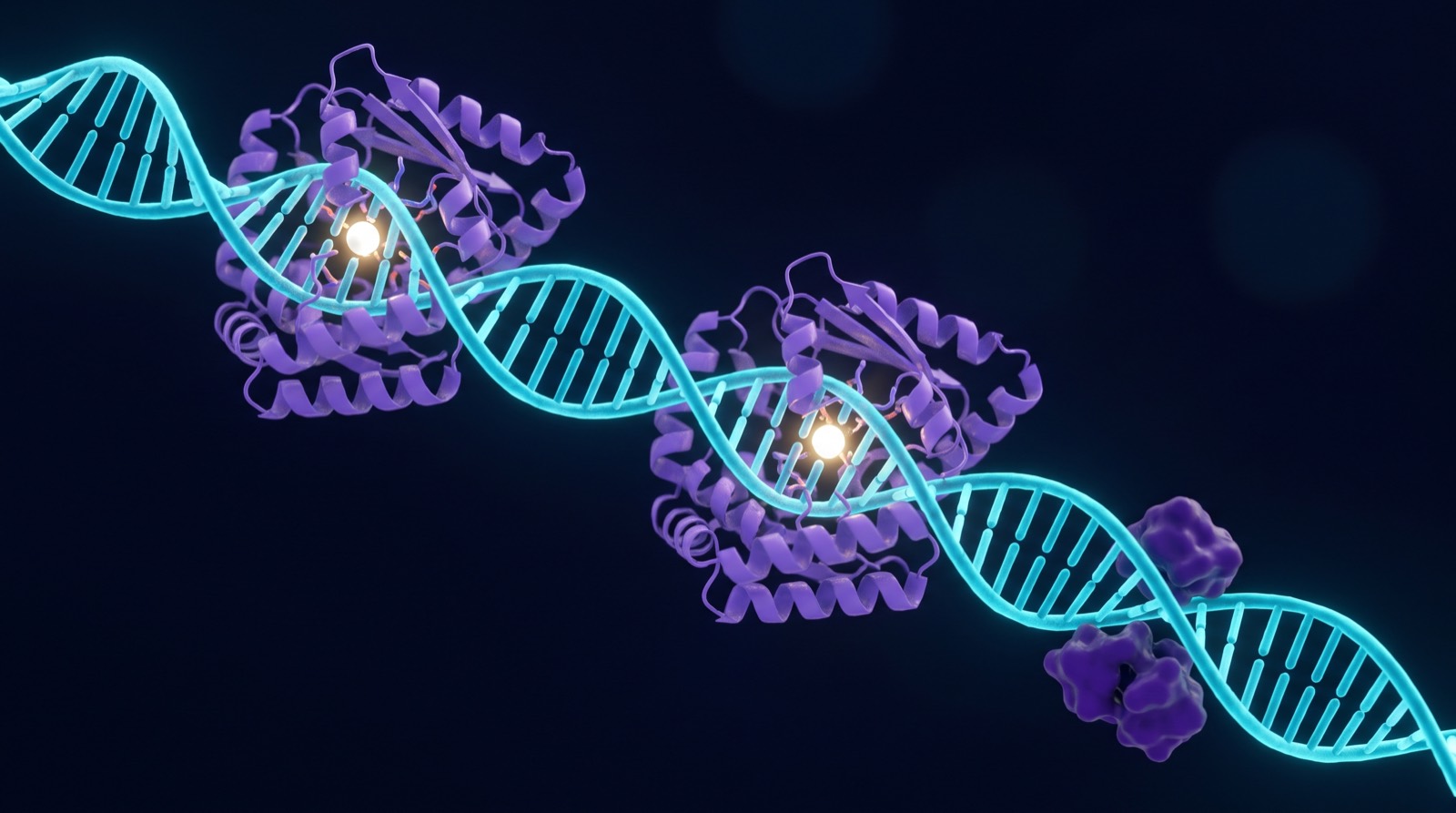
Zinc finger domains, each cradling a metal ion, reading DNA in blocks. Illustration generated for The CRISPR Atlas — a visual aid, not a photograph or a literal depiction of molecular structure.

Sources

Connected in the Atlas

Every entry on this site is linked to the others it relates to. These connections are part of the record, not a search result.

Apenas informação educativa Esta página é uma referência, não aconselhamento médico. O estado da investigação e o estado regulatório mudam; verifique a data da última atualização acima e confirme qualquer informação importante nas fontes primárias indicadas.