간단한 설명
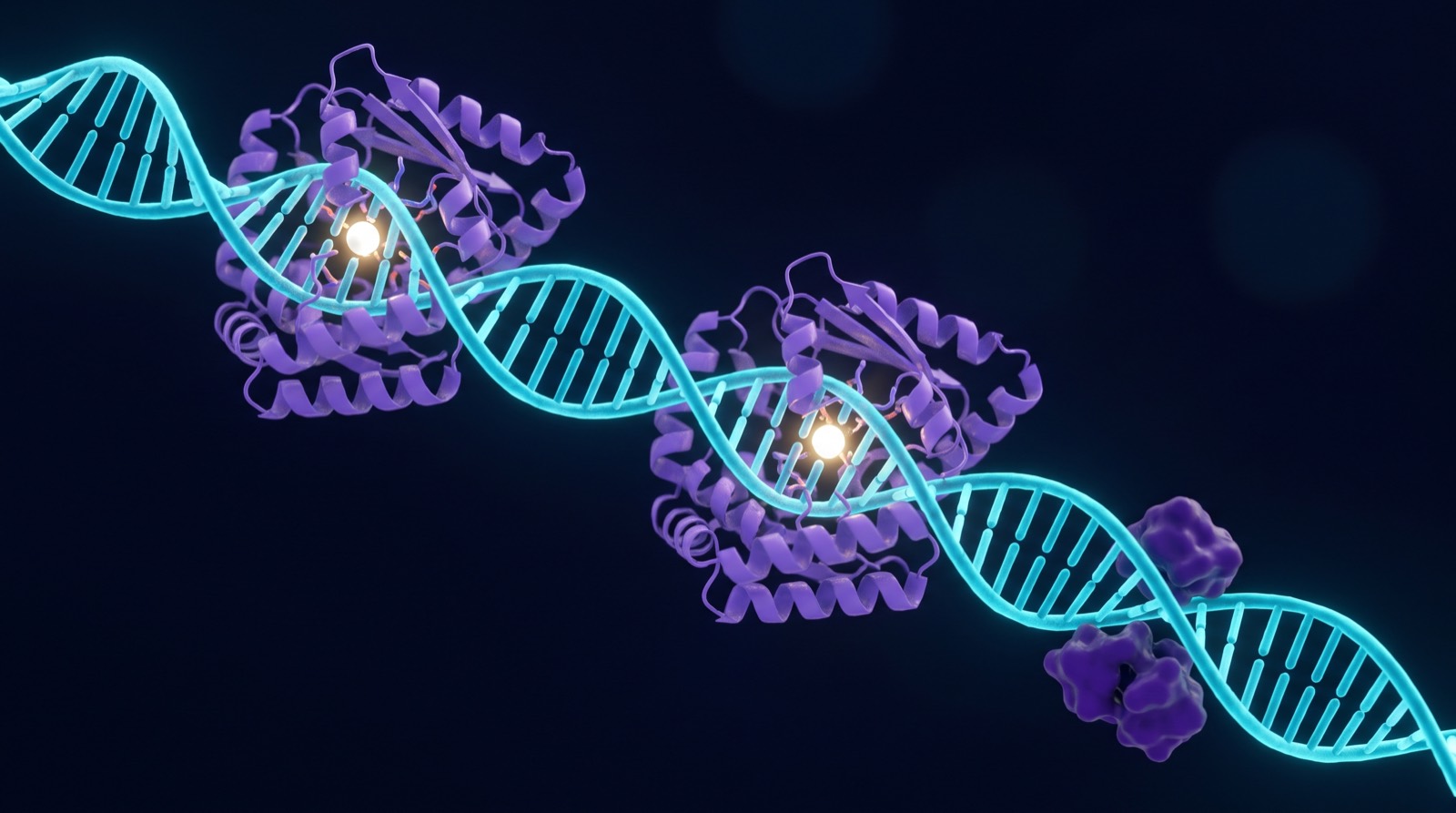
The original. Zinc fingers are small protein modules, each gripping about three letters of DNA, that can be chained together to recognise a longer sequence and joined to a cutting enzyme. They are difficult to design and they got there first: the earliest human gene-editing trials, more than a decade before CRISPR reached a patient, used zinc finger nucleases.
더 깊이 알아보기
Zinc finger nucleases fuse arrays of Cys2-His2 zinc finger domains, each contacting roughly three base pairs, to the FokI nuclease domain, and are used in pairs. Their compact size is a genuine advantage for AAV delivery. Their weakness is design: context-dependent binding between adjacent fingers makes engineering an array for a chosen sequence difficult, which is precisely the problem CRISPR made irrelevant.
Historical importance
ZFNs carried gene editing into humans. Sangamo's SB-728-T programme disrupted CCR5 in T cells of people with HIV from 2009, establishing that a targeted, permanent edit could be made in a patient's cells and administered safely enough to continue. Every subsequent editing programme was built on regulatory ground that work broke.
They remain in clinical development, particularly where compact size aids delivery.
Sources
- PNAS (Kim, Cha & Chandrasegaran) · 1996
Hybrid restriction enzymes: zinc finger fusions to Fok I cleavage domain ↗ - New England Journal of Medicine (Tebas et al.) · 2014
Gene editing of CCR5 in autologous CD4 T cells of persons infected with HIV ↗