Le guide de référence sur l'édition génomique.
Menu
Accueil Apprendre Actualités Demandez à l'Atlas
Explorer Technologies Maladies Traitements Essais cliniques Entreprises Scientifiques Gènes Recherche Institutions
Au-delà de la médecine Agriculture Éthique Investissement Carte du monde
Apprendre & Outils Commencer ici Glossaire A–Z Comparer les technologies Chronologie Listes & Classements Agents IA ★ Enregistré API
À propos À propos de nous Méthodologie Sources de données Politique éditoriale Contact Avertissements

🧭 Vue guidée
Nouveau en génétique ? Nous expliquons chaque terme au fil de votre navigation, en langage clair. Les mêmes pages, avec l'aide intégrée.

⚡ Point de vue d'expert
Vous connaissez déjà la biologie. Uniquement le contenu — clair et concis, sans explications supplémentaires. C'est l'affichage par défaut.

Langue de l'interface
Mode clair

Technology · Earlier generation

Zinc Finger Nucleases

The first programmable gene-editing tool to reach patients — small, engineered proteins that grip DNA in three-letter blocks.

Phase III DNAcuts DNAprotein-guidedcompact
Clinical research Being tested in people in registered clinical trials. Being in trials is not evidence that a treatment works or is safe.

Explication simple

The original. Zinc fingers are small protein modules, each gripping about three letters of DNA, that can be chained together to recognise a longer sequence and joined to a cutting enzyme. They are difficult to design and they got there first: the earliest human gene-editing trials, more than a decade before CRISPR reached a patient, used zinc finger nucleases.

Aller plus loin

Zinc finger nucleases fuse arrays of Cys2-His2 zinc finger domains — each contacting roughly three base pairs — to the FokI nuclease domain, used in pairs. Their compact size is a genuine advantage for AAV delivery. Their weakness is design: context-dependent binding between adjacent fingers makes engineering an array for a chosen sequence difficult, which is precisely the problem CRISPR made irrelevant.

Historical importance

ZFNs carried gene editing into humans. Sangamo's SB-728-T programme disrupted CCR5 in T cells of people with HIV from 2009, establishing that a targeted, permanent edit could be made in a patient's cells and administered safely enough to continue. Every subsequent editing programme was built on regulatory ground that work broke.

They remain in clinical development, particularly where compact size aids delivery.

Historical importance
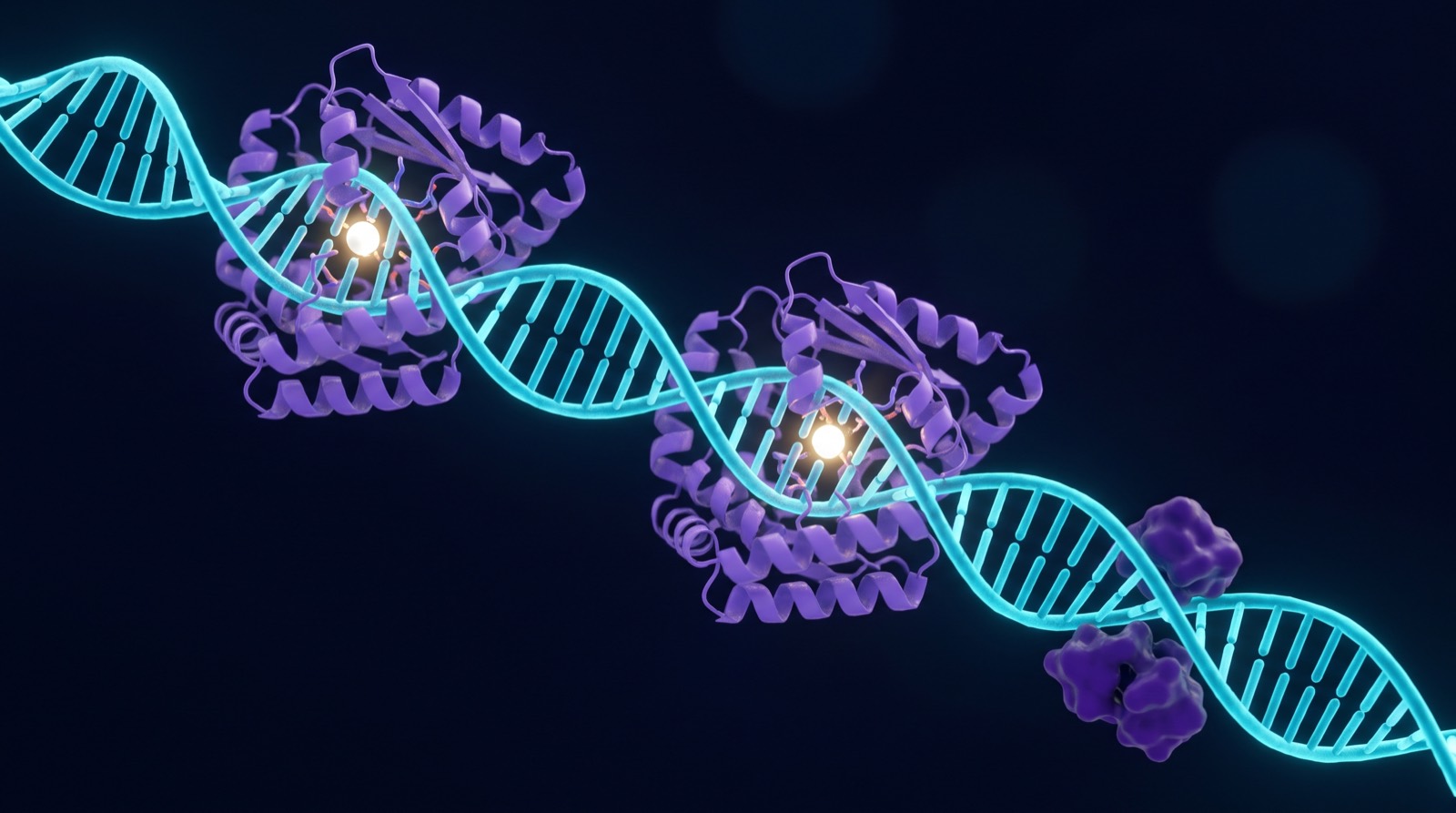
Zinc finger domains, each cradling a metal ion, reading DNA in blocks. Illustration generated for The CRISPR Atlas — a visual aid, not a photograph or a literal depiction of molecular structure.

Sources

Connected in the Atlas

Every entry on this site is linked to the others it relates to. These connections are part of the record, not a search result.

Information éducative uniquement Cette page est une ressource de référence, et non un conseil médical. L'état de la recherche et des autorisations réglementaires évolue ; vérifiez la date de dernière mise à jour ci-dessus et confirmez tout élément important auprès des sources primaires indiquées.