Hướng dẫn toàn diện về chỉnh sửa gene.
Menu
Trang chủ Tìm hiểu Tin tức Hỏi Atlas
Khám phá Các công nghệ Các bệnh Các phương pháp điều trị Thử nghiệm lâm sàng Các công ty Các nhà khoa học Các gene Nghiên cứu Tổ chức / Cơ sở
Ngoài y học Nông nghiệp Đạo đức Đầu tư Bản đồ thế giới
Tìm hiểu & Công cụ Bắt đầu tại đây Bảng thuật ngữ A–Z So sánh các công nghệ Dòng thời gian Danh sách & Xếp hạng AI Agents ★ Đã lưu API
Giới thiệu Về chúng tôi Phương pháp Nguồn dữ liệu Chính sách biên tập Liên hệ Tuyên bố miễn trừ trách nhiệm

🧭 Chế độ xem có hướng dẫn
Mới làm quen với di truyền học? Chúng tôi giải thích mọi thuật ngữ ngay khi bạn duyệt, bằng ngôn ngữ dễ hiểu. Cùng nội dung đó, nhưng có phần hỗ trợ tích hợp sẵn.

⚡ Góc nhìn chuyên gia
Bạn đã hiểu về sinh học rồi. Chỉ cần nội dung — gọn gàng và súc tích, không có giải thích thêm. Đây là chế độ xem mặc định.

Ngôn ngữ giao diện
Chế độ sáng

Disease · Neurological disease

Huntington's Disease

A fatal inherited brain disease caused by a toxic protein — where the genetics are unusually clear and the delivery problem is unusually hard.

Preclinical braindelivery problemHTT
Preclinical research Tested in cells and animals only. Most preclinical programmes never reach people, and animal results often do not carry over.

Giải thích đơn giản

A repeated stretch of DNA in one gene becomes too long, and the protein it makes gains a new, harmful property that slowly kills brain cells controlling movement, thinking and mood. The genetics could not be clearer: inherit the expansion and you will develop the disease. What is not clear is how to get an editing machine into billions of neurons, spread throughout the brain, behind a barrier evolved specifically to keep things out.

Tìm hiểu sâu hơn

Huntington's disease is caused by CAG repeat expansion in HTT, producing mutant huntingtin with a toxic gain of function; it is autosomal dominant with essentially complete penetrance above about 40 repeats. Because the pathology is gain-of-function, silencing or removing the mutant allele is the therapeutic goal — ideally allele-selectively, since wild-type huntingtin has essential functions. Delivery across the blood-brain barrier to sufficient neurons remains unsolved, and the fact that neurons do not divide means homology-directed repair is unavailable.

Two hard problems, not one

Delivery is the obvious one. The less obvious one is selectivity: everyone with Huntington's has one normal copy of the gene and one expanded copy, and the normal copy does something important. A treatment that silences both may create a new problem while solving the old one, so allele-selective approaches — targeting variants that happen to sit on the expanded copy — are an active area.

Non-editing approaches to lowering huntingtin have had a difficult clinical history, which has made the whole field appropriately cautious about this target.
Two hard problems, not one
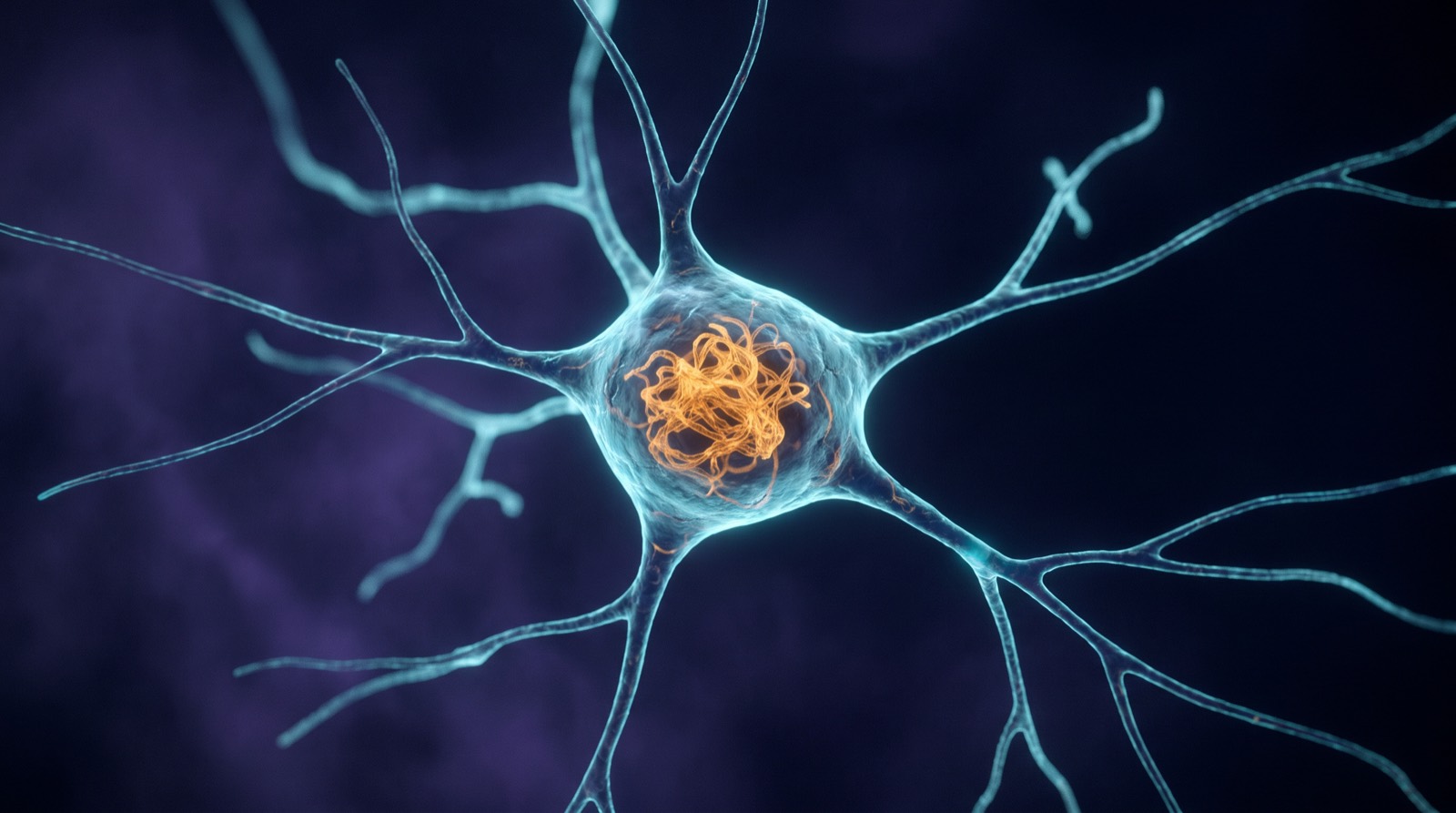
A neuron with an aggregate of misfolded protein in its cell body. Illustration generated for The CRISPR Atlas — a visual aid, not a photograph or a literal depiction of molecular structure.

Sources

Connected in the Atlas

Every entry on this site is linked to the others it relates to. These connections are part of the record, not a search result.

Technologies

CRISPR-Cas13

Genes

HTT
Chỉ mang tính chất thông tin giáo dục Trang này là tài liệu tham khảo, không phải tư vấn y tế. Tình trạng nghiên cứu và quy định thay đổi; hãy kiểm tra ngày cập nhật lần cuối ở trên và xác nhận mọi thông tin quan trọng với các nguồn chính được liệt kê.