Исчерпывающий путеводитель по редактированию генов.
Меню
Главная Учиться Новости Спросить Atlas
Изучить Технологии Заболевания Методы лечения Клинические исследования Компании Учёные Гены Исследования Учреждения
За пределами медицины Сельское хозяйство Этика Инвестирование Карта мира
Обучение и инструменты Начните здесь Глоссарий А–Я Сравнить технологии Хронология Списки и рейтинги ИИ-агенты ★ Сохранено API
О нас О нас Методология Источники данных Редакционная политика Контакты Отказ от ответственности

🧭 Режим с подсказками
Впервые в генетике? Мы объясняем каждый термин прямо в процессе просмотра, простым языком. Те же страницы — со встроенной подсказкой.

⚡ Взгляд эксперта
Биология вам уже знакома. Только содержание — чисто и компактно, без лишних пояснений. Это вид по умолчанию.

Язык интерфейса
Светлый режим

Disease · Neurological disease

Huntington's Disease

A fatal inherited brain disease caused by a toxic protein — where the genetics are unusually clear and the delivery problem is unusually hard.

Preclinical braindelivery problemHTT
Preclinical research Tested in cells and animals only. Most preclinical programmes never reach people, and animal results often do not carry over.

Простое объяснение

A repeated stretch of DNA in one gene becomes too long, and the protein it makes gains a new, harmful property that slowly kills brain cells controlling movement, thinking and mood. The genetics could not be clearer: inherit the expansion and you will develop the disease. What is not clear is how to get an editing machine into billions of neurons, spread throughout the brain, behind a barrier evolved specifically to keep things out.

Углубиться в тему

Huntington's disease is caused by CAG repeat expansion in HTT, producing mutant huntingtin with a toxic gain of function; it is autosomal dominant with essentially complete penetrance above about 40 repeats. Because the pathology is gain-of-function, silencing or removing the mutant allele is the therapeutic goal — ideally allele-selectively, since wild-type huntingtin has essential functions. Delivery across the blood-brain barrier to sufficient neurons remains unsolved, and the fact that neurons do not divide means homology-directed repair is unavailable.

Two hard problems, not one

Delivery is the obvious one. The less obvious one is selectivity: everyone with Huntington's has one normal copy of the gene and one expanded copy, and the normal copy does something important. A treatment that silences both may create a new problem while solving the old one, so allele-selective approaches — targeting variants that happen to sit on the expanded copy — are an active area.

Non-editing approaches to lowering huntingtin have had a difficult clinical history, which has made the whole field appropriately cautious about this target.
Two hard problems, not one
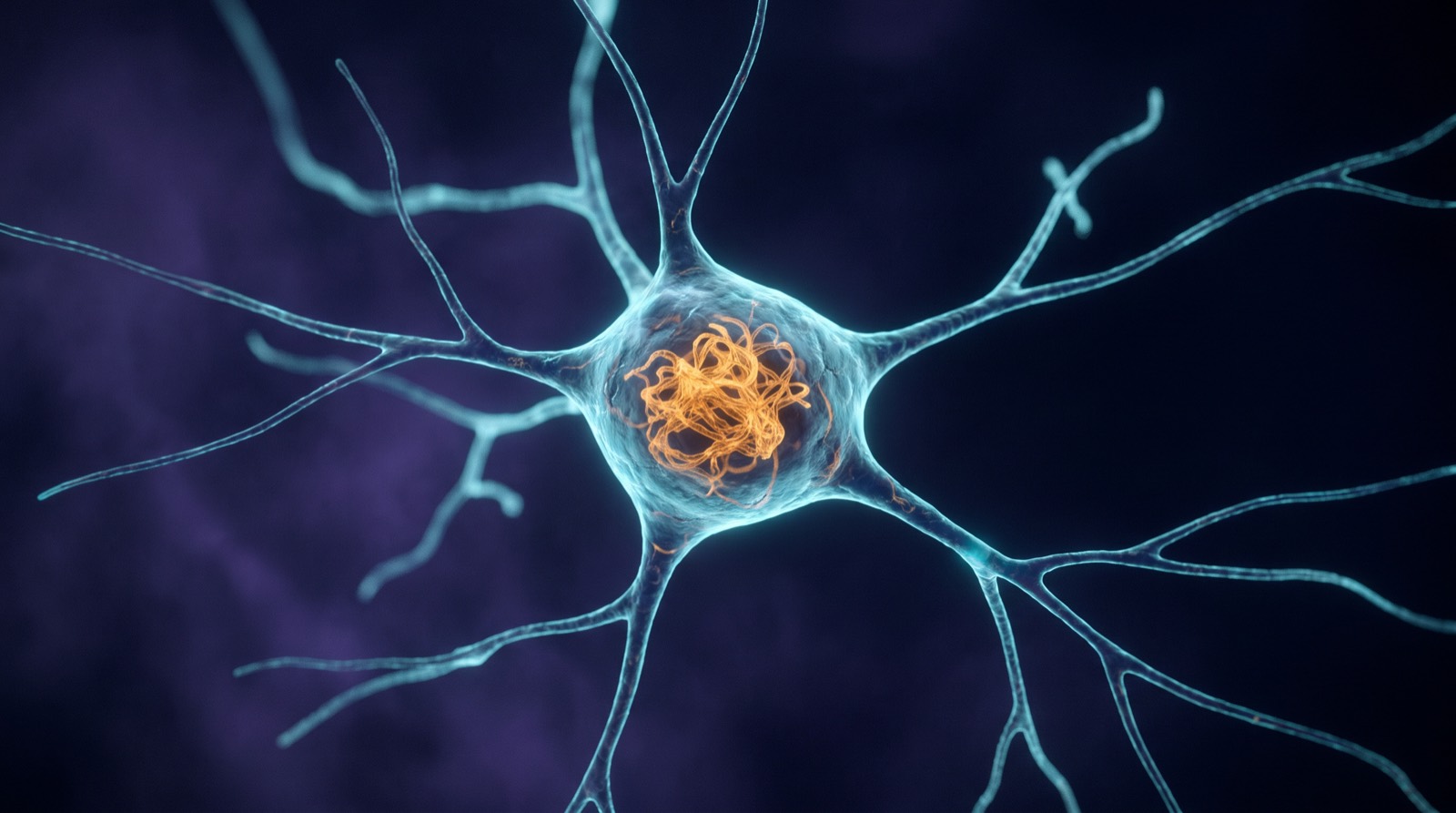
A neuron with an aggregate of misfolded protein in its cell body. Illustration generated for The CRISPR Atlas — a visual aid, not a photograph or a literal depiction of molecular structure.

Sources

Connected in the Atlas

Every entry on this site is linked to the others it relates to. These connections are part of the record, not a search result.

Technologies

CRISPR-Cas13

Genes

HTT
Только в образовательных целях Эта страница — справочный материал, а не медицинская консультация. Статусы исследований и регуляторных процессов меняются; проверяйте дату последнего обновления выше и уточняйте всё важное по первичным источникам, указанным на странице.