La guida definitiva all'editing genico.
Menu
Home Scopri Notizie Chiedi all'Atlas
Esplora Tecnologie Malattie Trattamenti Sperimentazioni cliniche Aziende Scienziati Geni Ricerca Istituzioni
Oltre la medicina Agricoltura Etica Investimenti Mappa del mondo
Scopri e strumenti Inizia da qui Glossario A–Z Confronta le tecnologie Cronologia Elenchi e classifiche Agenti IA ★ Salvato API
Informazioni Chi siamo Metodologia Fonti dei dati Politica editoriale Contatti Note legali

🧭 Vista guidata
Sei nuovo alla genetica? Spieghiamo ogni termine mentre navighi, in parole semplici. Le stesse pagine, con il supporto già incluso.

⚡ Parere degli esperti
Conosci già la biologia. Solo i contenuti — chiari e compatti, senza spiegazioni aggiuntive. Questa è la visualizzazione predefinita.

Lingua dell'interfaccia
Modalità chiara

Disease · Neurological disease

Huntington's Disease

A fatal inherited brain disease caused by a toxic protein — where the genetics are unusually clear and the delivery problem is unusually hard.

Preclinical braindelivery problemHTT
Preclinical research Tested in cells and animals only. Most preclinical programmes never reach people, and animal results often do not carry over.

Spiegazione semplice

A repeated stretch of DNA in one gene becomes too long, and the protein it makes gains a new, harmful property that slowly kills brain cells controlling movement, thinking and mood. The genetics could not be clearer: inherit the expansion and you will develop the disease. What is not clear is how to get an editing machine into billions of neurons, spread throughout the brain, behind a barrier evolved specifically to keep things out.

Approfondisci

Huntington's disease is caused by CAG repeat expansion in HTT, producing mutant huntingtin with a toxic gain of function; it is autosomal dominant with essentially complete penetrance above about 40 repeats. Because the pathology is gain-of-function, silencing or removing the mutant allele is the therapeutic goal — ideally allele-selectively, since wild-type huntingtin has essential functions. Delivery across the blood-brain barrier to sufficient neurons remains unsolved, and the fact that neurons do not divide means homology-directed repair is unavailable.

Two hard problems, not one

Delivery is the obvious one. The less obvious one is selectivity: everyone with Huntington's has one normal copy of the gene and one expanded copy, and the normal copy does something important. A treatment that silences both may create a new problem while solving the old one, so allele-selective approaches — targeting variants that happen to sit on the expanded copy — are an active area.

Non-editing approaches to lowering huntingtin have had a difficult clinical history, which has made the whole field appropriately cautious about this target.
Two hard problems, not one
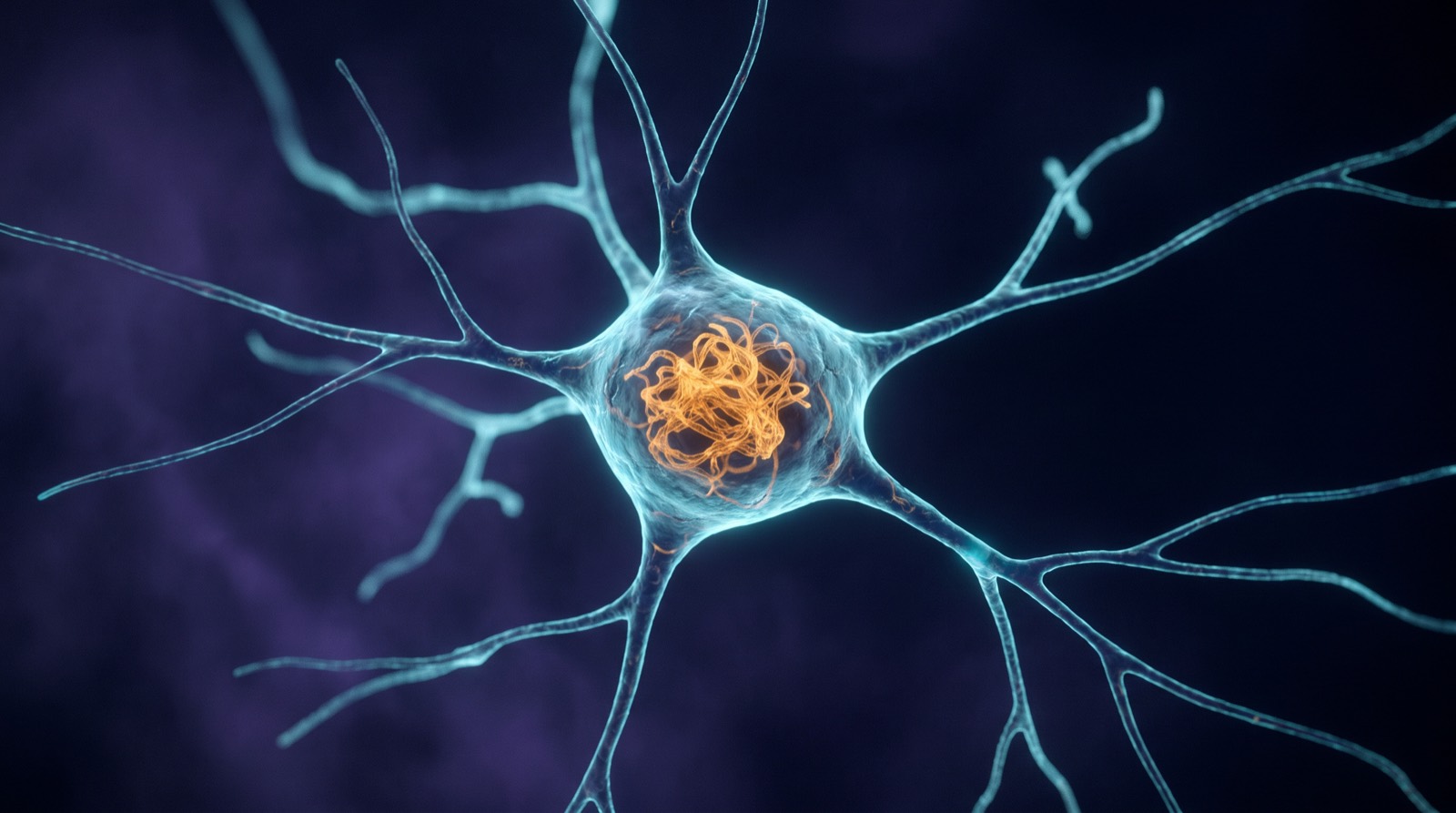
A neuron with an aggregate of misfolded protein in its cell body. Illustration generated for The CRISPR Atlas — a visual aid, not a photograph or a literal depiction of molecular structure.

Sources

Connected in the Atlas

Every entry on this site is linked to the others it relates to. These connections are part of the record, not a search result.

Technologies

CRISPR-Cas13

Genes

HTT
Solo informazioni educative Questa pagina è una risorsa di riferimento, non una consulenza medica. Lo stato della ricerca e delle autorizzazioni regolatorie cambia; controlla la data dell'ultimo aggiornamento in alto e verifica le informazioni importanti nelle fonti primarie elencate.