Der umfassende Leitfaden zum Genome Editing.
Menü
Startseite Lernen Neuigkeiten Den Atlas fragen
Entdecken Technologien Krankheiten Behandlungen Klinische Studien Unternehmen Wissenschaftlerinnen und Wissenschaftler Gene Forschung Institutionen
Jenseits der Medizin Landwirtschaft Ethik Investieren Weltkarte
Lernen & Tools Hier starten Glossar A–Z Technologien vergleichen Zeitstrahl Listen & Rankings KI-Agenten ★ Gespeichert API
Über uns Über uns Methodik Datenquellen Redaktionelle Richtlinien Kontakt Haftungsausschlüsse

🧭 Geführte Ansicht
Neu in der Genetik? Wir erklären jeden Begriff beim Stöbern in einfacher Sprache. Dieselben Seiten, mit integrierter Hilfe.

⚡ Expertenansicht
Du kennst die Biologie bereits. Nur der Inhalt – klar und kompakt, ohne zusätzliche Erklärungen. Das ist die Standardansicht.

Sprache der Benutzeroberfläche
Heller Modus

Disease · Neurological disease

Huntington's Disease

A fatal inherited brain disease caused by a toxic protein — where the genetics are unusually clear and the delivery problem is unusually hard.

Preclinical braindelivery problemHTT
Preclinical research Tested in cells and animals only. Most preclinical programmes never reach people, and animal results often do not carry over.

Einfache Erklärung

A repeated stretch of DNA in one gene becomes too long, and the protein it makes gains a new, harmful property that slowly kills brain cells controlling movement, thinking and mood. The genetics could not be clearer: inherit the expansion and you will develop the disease. What is not clear is how to get an editing machine into billions of neurons, spread throughout the brain, behind a barrier evolved specifically to keep things out.

Tiefer eintauchen

Huntington's disease is caused by CAG repeat expansion in HTT, producing mutant huntingtin with a toxic gain of function; it is autosomal dominant with essentially complete penetrance above about 40 repeats. Because the pathology is gain-of-function, silencing or removing the mutant allele is the therapeutic goal — ideally allele-selectively, since wild-type huntingtin has essential functions. Delivery across the blood-brain barrier to sufficient neurons remains unsolved, and the fact that neurons do not divide means homology-directed repair is unavailable.

Two hard problems, not one

Delivery is the obvious one. The less obvious one is selectivity: everyone with Huntington's has one normal copy of the gene and one expanded copy, and the normal copy does something important. A treatment that silences both may create a new problem while solving the old one, so allele-selective approaches — targeting variants that happen to sit on the expanded copy — are an active area.

Non-editing approaches to lowering huntingtin have had a difficult clinical history, which has made the whole field appropriately cautious about this target.
Two hard problems, not one
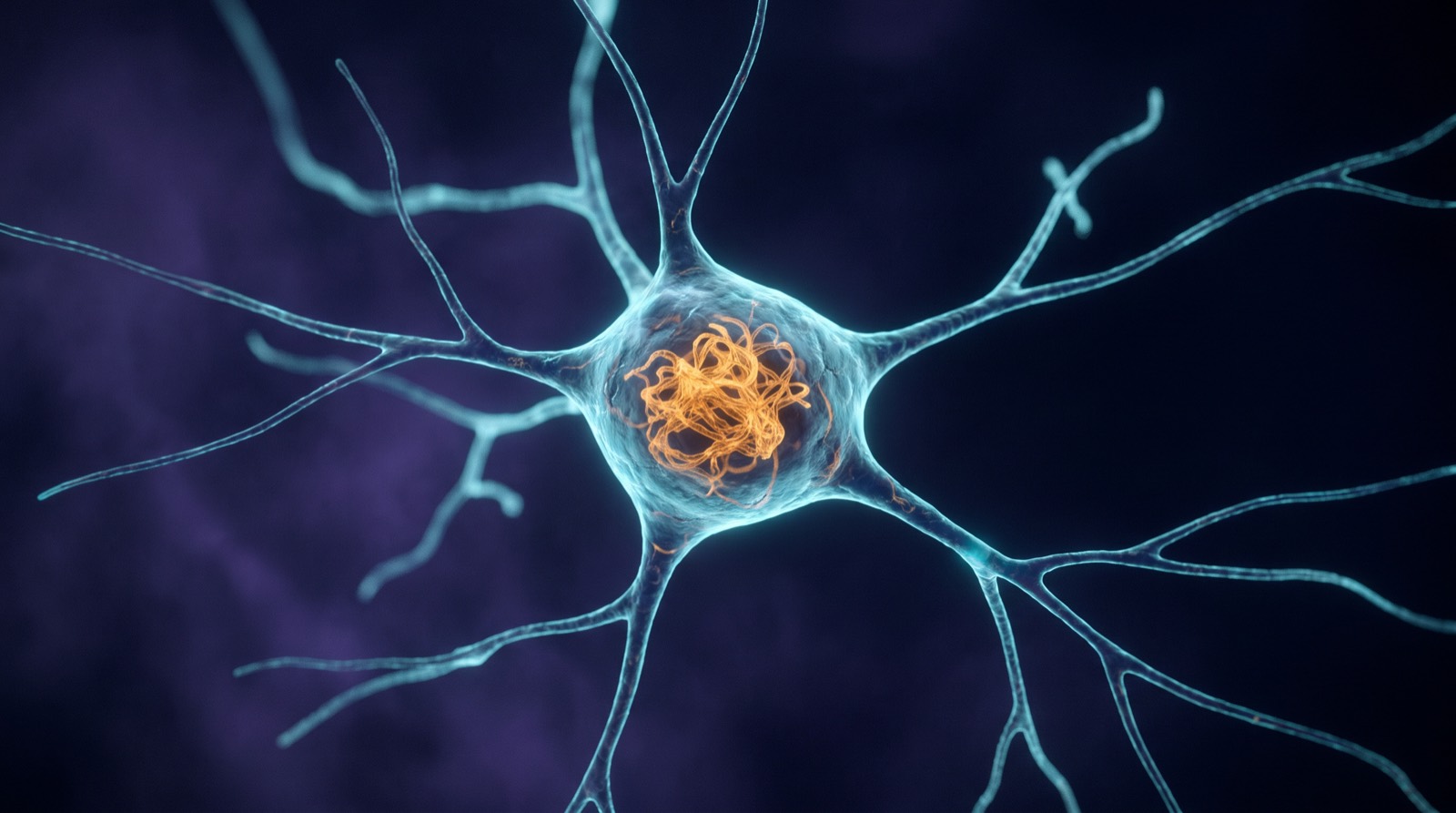
A neuron with an aggregate of misfolded protein in its cell body. Illustration generated for The CRISPR Atlas — a visual aid, not a photograph or a literal depiction of molecular structure.

Sources

Connected in the Atlas

Every entry on this site is linked to the others it relates to. These connections are part of the record, not a search result.

Technologies

CRISPR-Cas13

Genes

HTT
Nur zu Bildungszwecken Diese Seite ist eine Referenz, keine medizinische Beratung. Forschungs- und Zulassungsstatus können sich ändern; beachten Sie das oben angegebene Aktualisierungsdatum und gleichen Sie wichtige Informationen mit den aufgeführten Primärquellen ab.