Le guide de référence sur l'édition génomique.
Menu
Accueil Apprendre Actualités Demandez à l'Atlas
Explorer Technologies Maladies Traitements Essais cliniques Entreprises Scientifiques Gènes Recherche Institutions
Au-delà de la médecine Agriculture Éthique Investissement Carte du monde
Apprendre & Outils Commencer ici Glossaire A–Z Comparer les technologies Chronologie Listes & Classements Agents IA ★ Enregistré API
À propos À propos de nous Méthodologie Sources de données Politique éditoriale Contact Avertissements

🧭 Vue guidée
Nouveau en génétique ? Nous expliquons chaque terme au fil de votre navigation, en langage clair. Les mêmes pages, avec l'aide intégrée.

⚡ Point de vue d'expert
Vous connaissez déjà la biologie. Uniquement le contenu — clair et concis, sans explications supplémentaires. C'est l'affichage par défaut.

Langue de l'interface
Mode clair

Disease · Rare genetic disease

Cystic Fibrosis

A disease of thick mucus in the lungs and gut where highly effective drugs already exist for most patients — leaving editing to address the minority they do not help.

Preclinical lungdelivery problemCFTR
Preclinical research Tested in cells and animals only. Most preclinical programmes never reach people, and animal results often do not carry over.

Explication simple

A faulty channel protein stops salt and water moving properly across cell surfaces, so mucus becomes thick and sticky, clogging the lungs and the pancreas. Cystic fibrosis is unusual on this site because the drug treatments that arrived in the last decade are genuinely transformative for most patients. The remaining problem is the minority whose particular mutations those drugs cannot help — and reaching the airway surface, which turns out to be very good at keeping things out.

Aller plus loin

Cystic fibrosis is caused by biallelic CFTR mutations impairing chloride transport. CFTR modulators, particularly elexacaftor/tezacaftor/ivacaftor, produce substantial clinical benefit for patients with responsive genotypes — the large majority — but do not help those with nonsense or rare mutations lacking sufficient protein to modulate. Editing must reach airway basal stem cells through mucus, cilia and epithelial barriers evolved specifically to exclude foreign material, and must correct enough of them for the effect to persist as the epithelium renews.

Why the bar is high here

When effective drugs exist, a permanent intervention has to justify itself against them. For most people with cystic fibrosis, modulator therapy is the answer and editing is not needed. For the minority of patients whose mutations produce no protein for a modulator to act on, there is currently no equivalent option — and that is the population editing programmes are aimed at.

The delivery problem is severe. Inhaled lipid nanoparticles are the most-pursued route; work remains preclinical.

Why the bar is high here
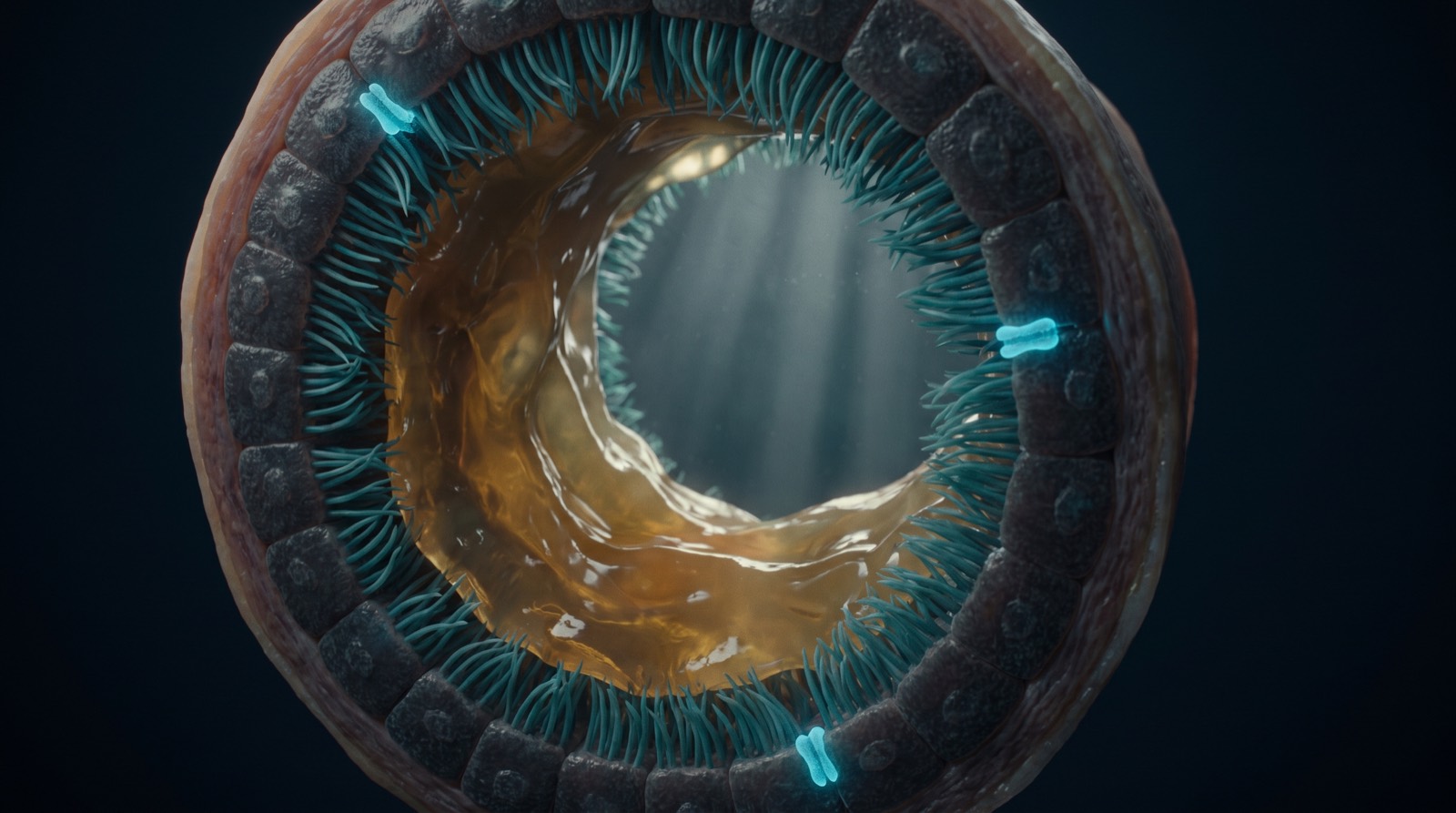
An airway lined with cilia, obstructed by thickened mucus. Illustration generated for The CRISPR Atlas — a visual aid, not a photograph or a literal depiction of molecular structure.

Sources

Connected in the Atlas

Every entry on this site is linked to the others it relates to. These connections are part of the record, not a search result.

Technologies

Prime Editing

Genes

CFTR
Information éducative uniquement Cette page est une ressource de référence, et non un conseil médical. L'état de la recherche et des autorisations réglementaires évolue ; vérifiez la date de dernière mise à jour ci-dessus et confirmez tout élément important auprès des sources primaires indiquées.