O guia definitivo sobre edição genética.
Menu
Início Aprender Notícias Perguntar ao Atlas
Explorar Tecnologias Doenças Tratamentos Ensaios Clínicos Empresas Cientistas Genes Investigação Instituições
Para além da medicina Agricultura Ética Investimento Mapa mundial
Aprender e ferramentas Comece aqui Glossário A–Z Comparar tecnologias Cronologia Listas e rankings Agentes de IA ★ Guardado API
Sobre Sobre nós Metodologia Fontes de dados Política editorial Contato Avisos legais

🧭 Vista Guiada
É novo em genética? Explicamos cada termo à medida que navega, em linguagem simples. As mesmas páginas, com a ajuda integrada.

⚡ Opinião de Especialista
Você já conhece a biologia. Apenas o conteúdo — limpo e compacto, sem explicações extras. Esta é a visualização padrão.

Idioma da interface
Modo claro

Disease · Neurological disease

Alzheimer's Disease

The most common cause of dementia, where a well-known risk gene exists but editing remains firmly a laboratory activity.

Discovery braincomplex geneticsAPOE
Laboratory research Demonstrated in the laboratory. There is no treatment in or near the clinic for this use.

Explicação simples

Alzheimer's disease damages memory and thinking as abnormal protein deposits build up in the brain and neurons are lost. A gene called APOE strongly influences risk — one version raises it substantially, another lowers it — but risk is not cause: many people with the high-risk version never develop the disease, and many people with the disease do not carry it. Editing a risk factor in a living adult brain is not something anyone can currently do, and it is not obvious it would help if they could.

Aprofundar

Late-onset Alzheimer's disease is polygenic with APOE ε4 the strongest common risk allele; rare autosomal dominant forms involve APP, PSEN1 and PSEN2. Editing is used to build isogenic models — for example converting APOE ε4 to ε3 or ε2 in patient-derived neurons — and to study protective variants such as the Christchurch APOE variant and the APP A673T allele. Therapeutic editing faces the same barriers as other brain indications, compounded by the difficulty of intervening before irreversible damage.

Risk is not cause

This distinction matters more here than almost anywhere else on the site. APOE ε4 shifts probability; it does not determine outcome. An intervention against a risk factor would need to be given long before symptoms, to people who might never have developed the disease, with permanent effect — a risk-benefit calculation quite unlike treating an established condition.

Risk is not cause
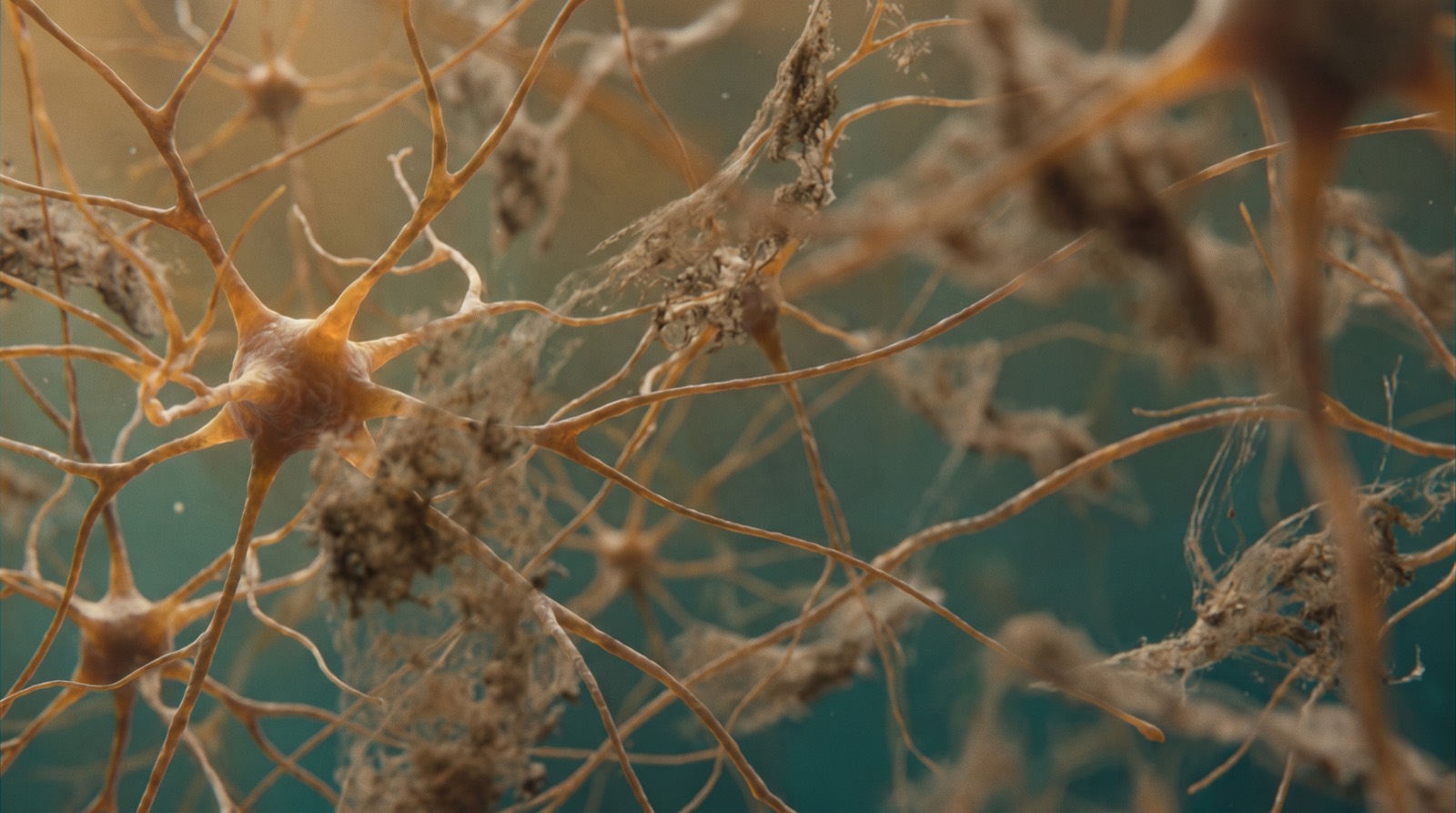
Neurons obscured by protein deposits. Illustration generated for The CRISPR Atlas — a visual aid, not a photograph or a literal depiction of molecular structure.

Sources

Connected in the Atlas

Every entry on this site is linked to the others it relates to. These connections are part of the record, not a search result.

Genes

APOE
Apenas informação educativa Esta página é uma referência, não aconselhamento médico. O estado da investigação e o estado regulatório mudam; verifique a data da última atualização acima e confirme qualquer informação importante nas fontes primárias indicadas.