De definitieve gids voor genbewerking.
Menu
Home Leren Nieuws Vraag de Atlas
Verkennen Technologieën Ziekten Behandelingen Klinische onderzoeken Bedrijven Wetenschappers Genen Onderzoek Instellingen
Verder dan geneeskunde Landbouw Ethiek Investeren Wereldkaart
Leren & Tools Begin hier Woordenlijst A–Z Vergelijk technologieën Tijdlijn Lijsten & Rankings AI-agents ★ Opgeslagen API
Over Over ons Methodologie Databronnen Redactioneel beleid Contact Disclaimers

🧭 Begeleide weergave
Nieuw in de genetica? We leggen elk begrip uit terwijl je bladert, in gewone taal. Dezelfde pagina's, met de hulp ingebouwd.

⚡ Expertvisie
Je kent de biologie al. Alleen de inhoud — helder en compact, zonder extra uitleg. Dit is de standaardweergave.

Interfacetaal
Lichte modus

Disease · Neurological disease

Alzheimer's Disease

The most common cause of dementia, where a well-known risk gene exists but editing remains firmly a laboratory activity.

Discovery braincomplex geneticsAPOE
Laboratory research Demonstrated in the laboratory. There is no treatment in or near the clinic for this use.

Eenvoudige uitleg

Alzheimer's disease damages memory and thinking as abnormal protein deposits build up in the brain and neurons are lost. A gene called APOE strongly influences risk — one version raises it substantially, another lowers it — but risk is not cause: many people with the high-risk version never develop the disease, and many people with the disease do not carry it. Editing a risk factor in a living adult brain is not something anyone can currently do, and it is not obvious it would help if they could.

Dieper ingaan

Late-onset Alzheimer's disease is polygenic with APOE ε4 the strongest common risk allele; rare autosomal dominant forms involve APP, PSEN1 and PSEN2. Editing is used to build isogenic models — for example converting APOE ε4 to ε3 or ε2 in patient-derived neurons — and to study protective variants such as the Christchurch APOE variant and the APP A673T allele. Therapeutic editing faces the same barriers as other brain indications, compounded by the difficulty of intervening before irreversible damage.

Risk is not cause

This distinction matters more here than almost anywhere else on the site. APOE ε4 shifts probability; it does not determine outcome. An intervention against a risk factor would need to be given long before symptoms, to people who might never have developed the disease, with permanent effect — a risk-benefit calculation quite unlike treating an established condition.

Risk is not cause
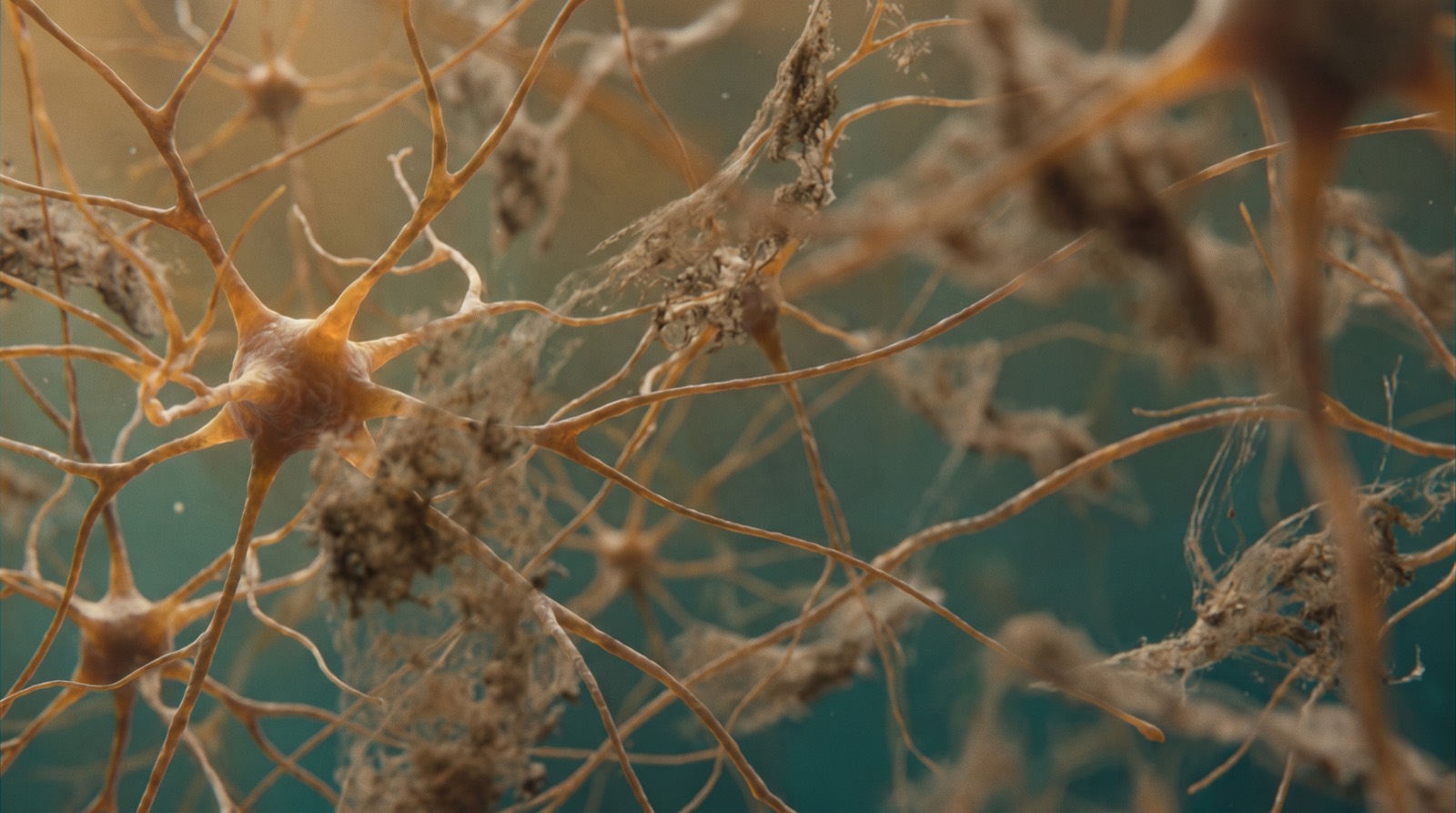
Neurons obscured by protein deposits. Illustration generated for The CRISPR Atlas — a visual aid, not a photograph or a literal depiction of molecular structure.

Sources

Connected in the Atlas

Every entry on this site is linked to the others it relates to. These connections are part of the record, not a search result.

Genes

APOE
Alleen educatieve informatie Deze pagina is een naslagbron, geen medisch advies. Onderzoeks- en regelgevingsstatus veranderen; controleer de datum van de laatste update hierboven en verifieer belangrijke informatie bij de vermelde primaire bronnen.