Le guide de référence sur l'édition génomique.
Menu
Accueil Apprendre Actualités Demandez à l'Atlas
Explorer Technologies Maladies Traitements Essais cliniques Entreprises Scientifiques Gènes Recherche Institutions
Au-delà de la médecine Agriculture Éthique Investissement Carte du monde
Apprendre & Outils Commencer ici Glossaire A–Z Comparer les technologies Chronologie Listes & Classements Agents IA ★ Enregistré API
À propos À propos de nous Méthodologie Sources de données Politique éditoriale Contact Avertissements

🧭 Vue guidée
Nouveau en génétique ? Nous expliquons chaque terme au fil de votre navigation, en langage clair. Les mêmes pages, avec l'aide intégrée.

⚡ Point de vue d'expert
Vous connaissez déjà la biologie. Uniquement le contenu — clair et concis, sans explications supplémentaires. C'est l'affichage par défaut.

Langue de l'interface
Mode clair

Disease · Neurological disease

Alzheimer's Disease

The most common cause of dementia, where a well-known risk gene exists but editing remains firmly a laboratory activity.

Discovery braincomplex geneticsAPOE
Laboratory research Demonstrated in the laboratory. There is no treatment in or near the clinic for this use.

Explication simple

Alzheimer's disease damages memory and thinking as abnormal protein deposits build up in the brain and neurons are lost. A gene called APOE strongly influences risk — one version raises it substantially, another lowers it — but risk is not cause: many people with the high-risk version never develop the disease, and many people with the disease do not carry it. Editing a risk factor in a living adult brain is not something anyone can currently do, and it is not obvious it would help if they could.

Aller plus loin

Late-onset Alzheimer's disease is polygenic with APOE ε4 the strongest common risk allele; rare autosomal dominant forms involve APP, PSEN1 and PSEN2. Editing is used to build isogenic models — for example converting APOE ε4 to ε3 or ε2 in patient-derived neurons — and to study protective variants such as the Christchurch APOE variant and the APP A673T allele. Therapeutic editing faces the same barriers as other brain indications, compounded by the difficulty of intervening before irreversible damage.

Risk is not cause

This distinction matters more here than almost anywhere else on the site. APOE ε4 shifts probability; it does not determine outcome. An intervention against a risk factor would need to be given long before symptoms, to people who might never have developed the disease, with permanent effect — a risk-benefit calculation quite unlike treating an established condition.

Risk is not cause
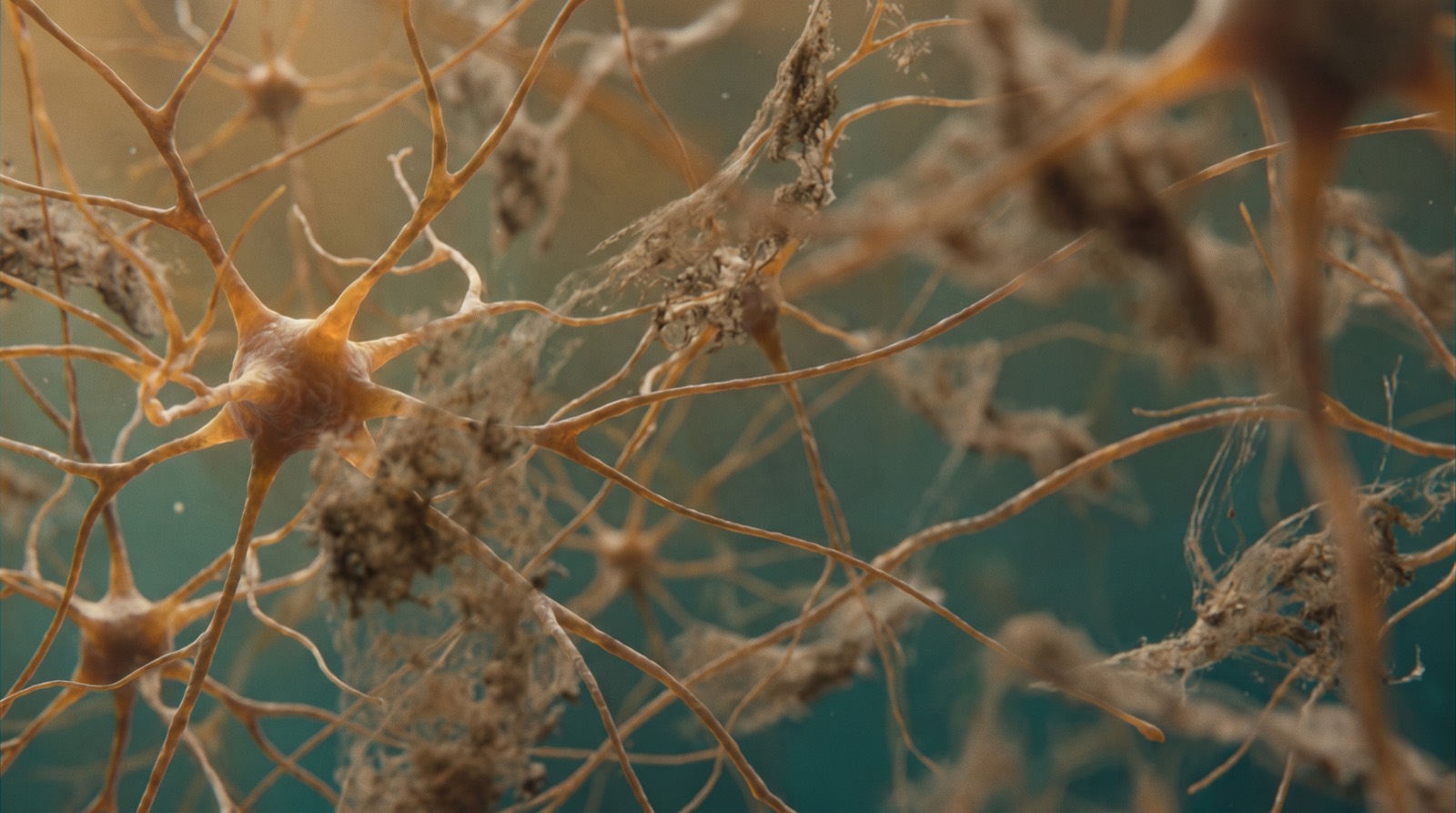
Neurons obscured by protein deposits. Illustration generated for The CRISPR Atlas — a visual aid, not a photograph or a literal depiction of molecular structure.

Sources

Connected in the Atlas

Every entry on this site is linked to the others it relates to. These connections are part of the record, not a search result.

Genes

APOE
Information éducative uniquement Cette page est une ressource de référence, et non un conseil médical. L'état de la recherche et des autorisations réglementaires évolue ; vérifiez la date de dernière mise à jour ci-dessus et confirmez tout élément important auprès des sources primaires indiquées.