Der umfassende Leitfaden zum Genome Editing.
Menü
Startseite Lernen Neuigkeiten Den Atlas fragen
Entdecken Technologien Krankheiten Behandlungen Klinische Studien Unternehmen Wissenschaftlerinnen und Wissenschaftler Gene Forschung Institutionen
Jenseits der Medizin Landwirtschaft Ethik Investieren Weltkarte
Lernen & Tools Hier starten Glossar A–Z Technologien vergleichen Zeitstrahl Listen & Rankings KI-Agenten ★ Gespeichert API
Über uns Über uns Methodik Datenquellen Redaktionelle Richtlinien Kontakt Haftungsausschlüsse

🧭 Geführte Ansicht
Neu in der Genetik? Wir erklären jeden Begriff beim Stöbern in einfacher Sprache. Dieselben Seiten, mit integrierter Hilfe.

⚡ Expertenansicht
Du kennst die Biologie bereits. Nur der Inhalt – klar und kompakt, ohne zusätzliche Erklärungen. Das ist die Standardansicht.

Sprache der Benutzeroberfläche
Heller Modus

Disease · Neurological disease

Alzheimer's Disease

The most common cause of dementia, where a well-known risk gene exists but editing remains firmly a laboratory activity.

Discovery braincomplex geneticsAPOE
Laboratory research Demonstrated in the laboratory. There is no treatment in or near the clinic for this use.

Einfache Erklärung

Alzheimer's disease damages memory and thinking as abnormal protein deposits build up in the brain and neurons are lost. A gene called APOE strongly influences risk — one version raises it substantially, another lowers it — but risk is not cause: many people with the high-risk version never develop the disease, and many people with the disease do not carry it. Editing a risk factor in a living adult brain is not something anyone can currently do, and it is not obvious it would help if they could.

Tiefer eintauchen

Late-onset Alzheimer's disease is polygenic with APOE ε4 the strongest common risk allele; rare autosomal dominant forms involve APP, PSEN1 and PSEN2. Editing is used to build isogenic models — for example converting APOE ε4 to ε3 or ε2 in patient-derived neurons — and to study protective variants such as the Christchurch APOE variant and the APP A673T allele. Therapeutic editing faces the same barriers as other brain indications, compounded by the difficulty of intervening before irreversible damage.

Risk is not cause

This distinction matters more here than almost anywhere else on the site. APOE ε4 shifts probability; it does not determine outcome. An intervention against a risk factor would need to be given long before symptoms, to people who might never have developed the disease, with permanent effect — a risk-benefit calculation quite unlike treating an established condition.

Risk is not cause
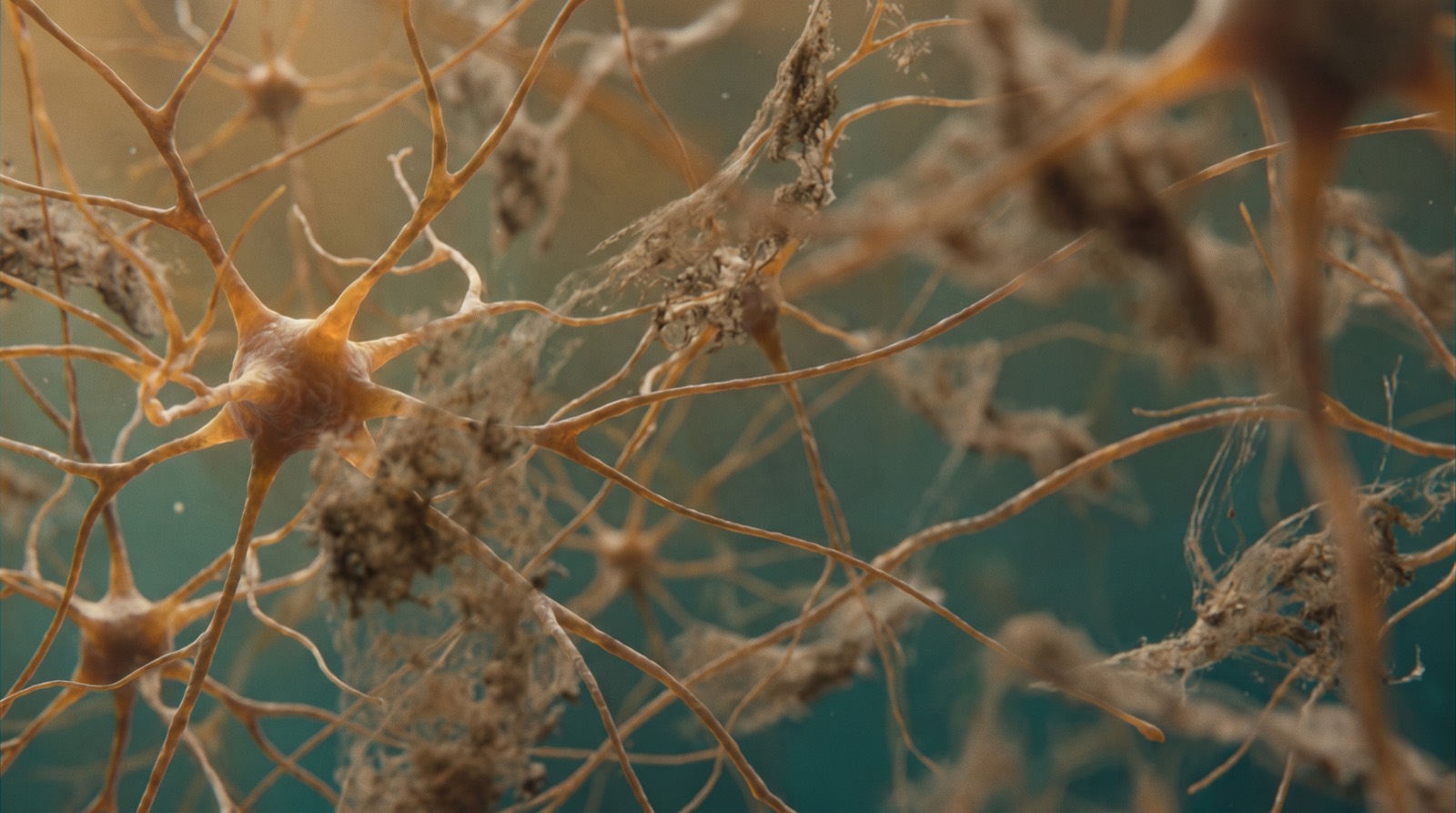
Neurons obscured by protein deposits. Illustration generated for The CRISPR Atlas — a visual aid, not a photograph or a literal depiction of molecular structure.

Sources

Connected in the Atlas

Every entry on this site is linked to the others it relates to. These connections are part of the record, not a search result.

Genes

APOE
Nur zu Bildungszwecken Diese Seite ist eine Referenz, keine medizinische Beratung. Forschungs- und Zulassungsstatus können sich ändern; beachten Sie das oben angegebene Aktualisierungsdatum und gleichen Sie wichtige Informationen mit den aufgeführten Primärquellen ab.